The attack
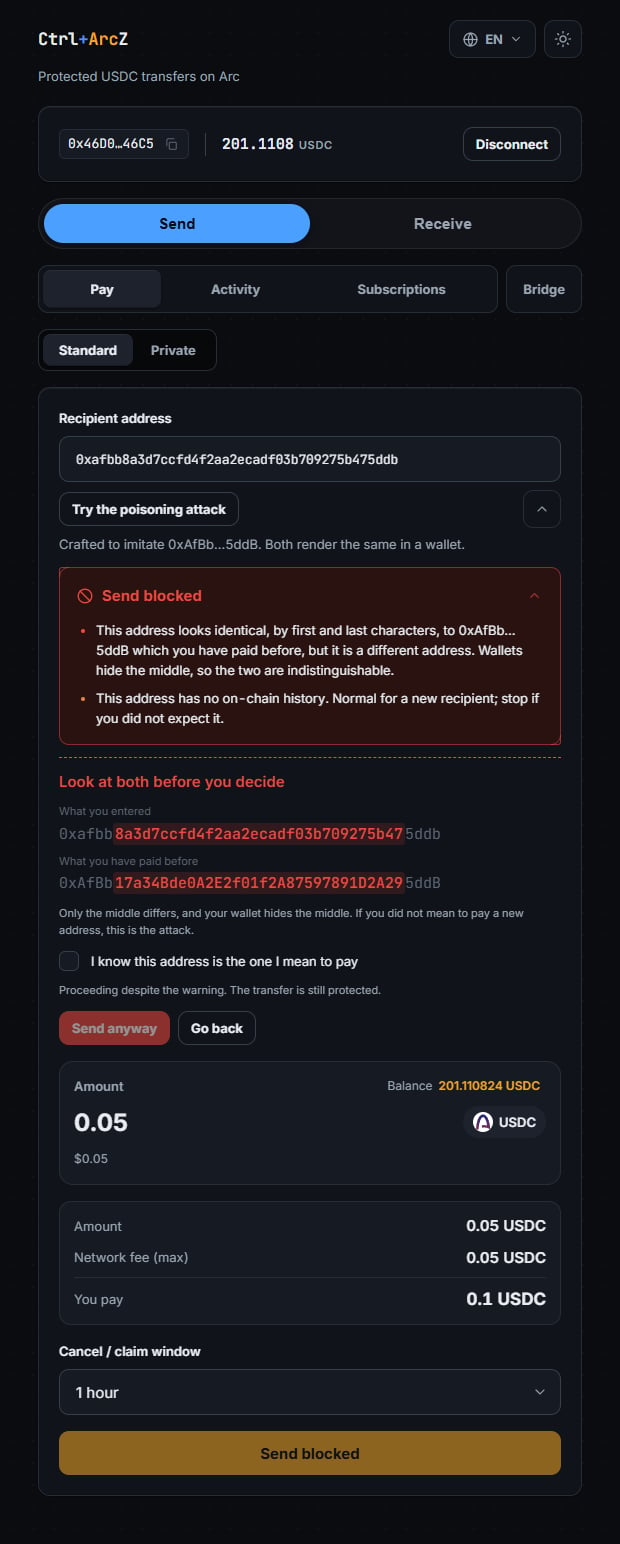
An attacker mints a lookalike of an address you actually pay: a different address that shares the same first and last visible characters. Wallets abbreviate addresses as0x3A5f…9C2b, so the middle is never shown, and a vanity grinder
produces a matching pair in seconds.
The attacker then plants that lookalike in your history so it sits next to the
real address:
- Zero-value bait. They send you a 0-value token transfer from the lookalike. Sending someone 0 tokens has no legitimate purpose. It exists only to make the address appear in your history as if you had interacted with it.
- Dust. A tiny non-zero transfer does the same, dressed up to look like a real payment.
- Spoofed token. A fake token contract emits a transfer that names the lookalike, so it shows up in your activity feed.
Why locking funds after the fact does not save you
This is the key insight, and it is baked into the firewall’s own framing:In a poisoning attack the victim sends to the wrong address on purpose. They
believe it is the right one. Escrow, clawback, or a code-gated claim protect you
from a recipient who should not receive the funds. Here you chose the recipient.
The only protection that works is refusing to send in the first place.
How the firewall detects it
The firewall assembles a report from on-chain data and runs a pure rule engine over it. The rules, and the constants they use, live in the SDK:Lookalike match (LOOKALIKE_ADDRESS, block)
Lookalike match (LOOKALIKE_ADDRESS, block)
isLookalike compares the target against every address you have paid before. A
match means the first AFFIX_LENGTH (4) hex characters and the last
AFFIX_LENGTH characters are identical, while the full address is not. That is
exactly the signature of a poisoning lookalike, and it is a hard block. Your
verified recipients feed this list too, so a lookalike of an address you reached
through a protected transfer is caught as well.Zero-value bait (ZERO_VALUE_BAIT, block)
Zero-value bait (ZERO_VALUE_BAIT, block)
If the target has ever sent you a 0-value transfer, that is counted and blocked.
This is not a heuristic. A 0-value transfer has no honest use, so its presence is
treated as proof of a planting attempt, not a warning.
Fresh or new address (FRESH_ADDRESS / NEW_ADDRESS, warning)
Fresh or new address (FRESH_ADDRESS / NEW_ADDRESS, warning)
A poisoning address is minted for the attack, so it is almost always brand new. If
the target has no on-chain history at all, that is
NEW_ADDRESS. If its first
activity is within FRESH_ADDRESS_MAX_AGE_MS (24 hours), that is FRESH_ADDRESS.
Both are warnings, not blocks: a brand-new recipient is also the most common
legitimate payment there is.Positive signals (VERIFIED_RECIPIENT / KNOWN_COUNTERPARTY, safe)
Positive signals (VERIFIED_RECIPIENT / KNOWN_COUNTERPARTY, safe)
If a protected transfer to this exact address has settled before, that is
VERIFIED_RECIPIENT. If you have simply paid this exact address before, that is
KNOWN_COUNTERPARTY. These reassure, but they never override a block: an address
you paid last week does not make its lookalike safe.The verdict, and fail-closed
The report carries a singlelevel:
- safe proceeds.
- warning asks you to look again (the default policy lets it through; an integrator config can escalate it to a block).
- block stops the send. A lookalike, a zero-value bait, or a scan that could not rule a lookalike out all land here.
complete: false) and it is never
reported as safe. When the missing source is your send history, the lookalike
rule could not run at all, so an unverified target is blocked outright rather than
merely warned: a firewall that waves traffic through when its data source is down
is worse than none.
A report is a snapshot taken at
checkedAt. A bait transfer that lands after it
was taken would not appear in it, so sendProtected re-scans rather than trusting
a report older than a short freshness window.Next
- Wire it into your send path: The firewall.
- The
checkfunction andRiskReportshape: SDK reference. - Where this layer fits with the others: Overview.